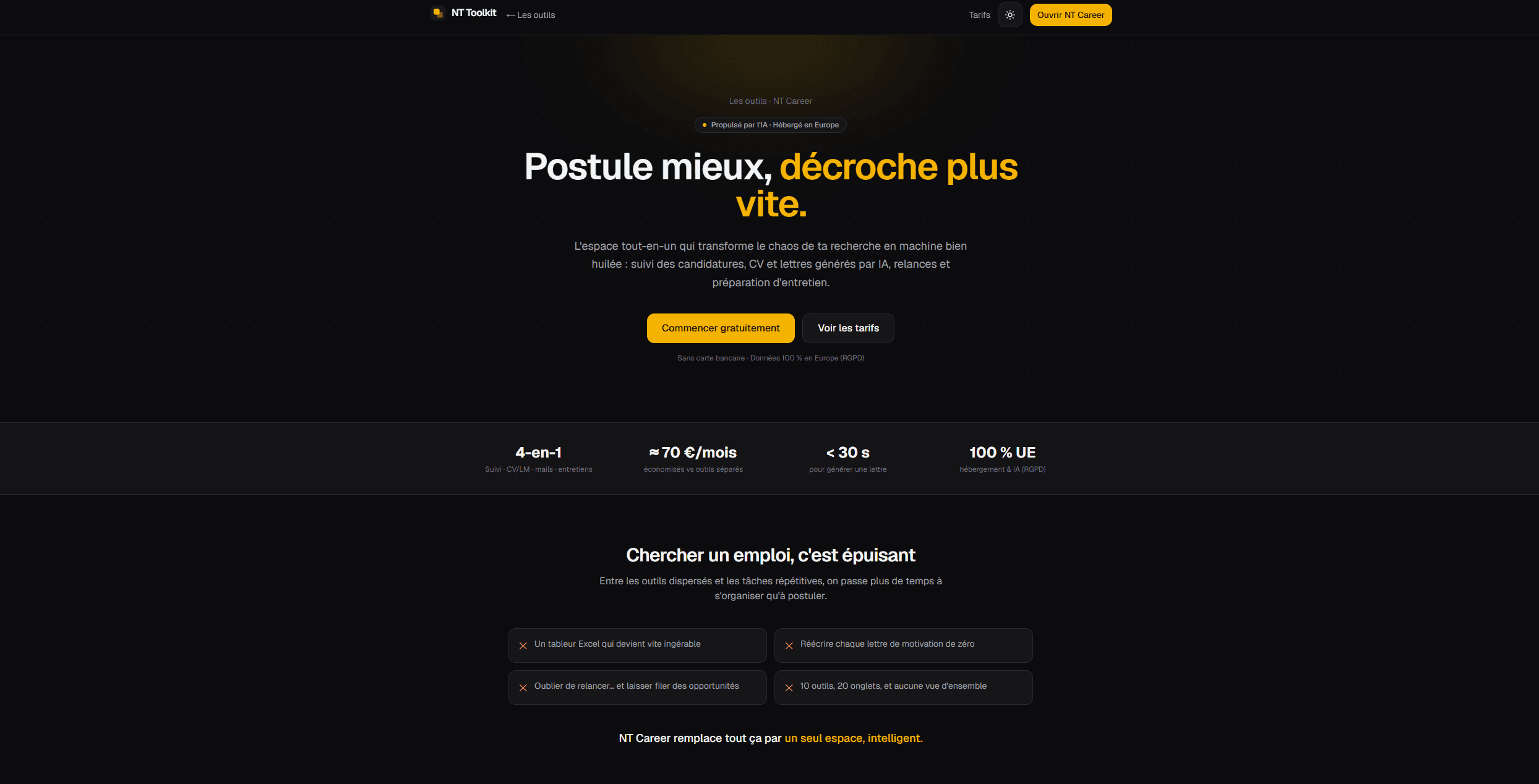
NT Career, a platform to help find work-study positions
A platform that automates the search for work-study positions, internships and jobs with AI, already tested by several schools.
Ongoing
Since September 2026
Personal
Development & Data / AI
Technologies
01The project
NT Career is a platform I'm building with a colleague. It helps students and job seekers automate their search for work-study positions, internships or jobs, so they spend less time on repetitive tasks and more on what really matters.
The platform is already being tested by several schools, which use it to support their students in their search.
02The user journey
Everything starts with a complete profile, with skills, education, achievements and the area where the user is looking. This profile then powers every feature.
The user can then prepare their documents. Cover letters and application emails can be written automatically, and the resume adapts to each job offer.
03A resume that adapts to each offer
The user imports their resume as a PDF, then places variables on it, such as the title, the subtitle or the city. When applying, the AI replaces each of them with content tailored to the offer. The title, for example, becomes the name of the targeted position, so the resume always matches the job posting. All that's left is to print it or send it.
A PDF eraser also makes it possible to truly remove text from the original document, without leaving a white box or any trace, to make room for a variable.
04Finding job offers
To avoid jumping from one website to another, the platform gathers all offers in one place, with several hundred thousand offers from France Travail, the French public employment service, updated every hour. Users can filter them by job title, location (anywhere, around a city or by department), contract type and publication date.
05Tracking applications
A dashboard gives the user a complete overview of their search at a glance.
At the top, key figures summarize their progress, with the number of applications sent, the response rate, the interviews landed and the saved offers. Just below, an application funnel shows where each application stops, from submission to responses, interviews and accepted offers. It's a valuable tool to understand what works, and what needs to improve.
To keep up the pace, the user sets a weekly application goal, and a chart tracks their activity week after week. The dashboard also highlights the most in-demand skills in the offers they applied to, to help them know what to emphasize or what to learn.
Finally, the platform suggests follow-ups, showing how long each application has been waiting for a reply, so that no opportunity slips away. When an interview is coming up, it prepares a list of points to review, tailored to the offer and the company.
06AI at the heart of the project
All these features rely on Mistral, a French large language model (LLM). We chose it partly for its data handling, compliant with the GDPR, an essential point when dealing with resumes and personal information.
I worked on the prompts, the instructions given to the AI, refining them through testing to get the most relevant results possible at every step.
To keep costs under control, each user has a daily quota for each use of the AI (cover letters, offer imports, interview preparation...), tracked directly from their dashboard.
07Sharing the roles
I mainly handle the development of the platform and the AI integration. My colleague focuses on cybersecurity, a major concern for a tool that stores personal data.
08What I take away from it
NT Career is the first project where I integrate a language model into a real product. I learned that the hardest part isn't calling the AI, but getting reliable and consistent results, which takes a lot of work on the prompts. I also discovered the constraints of a real service. Every call to the AI has a cost, hence the quotas, resumes contain personal data, hence the choice of a GDPR-compliant model, and hundreds of thousands of offers updated every hour require a well-designed database from the start.
On the professional side, building with a teammate taught me to clearly divide roles and align our choices, so that every feature stays secure. And since the platform is used by real students, I learned to think about users first, prioritizing what brings them the most value rather than what would be the most interesting to code.
Finally, this project means a lot to me, because I know the problem it solves. Building the tool I would have loved to have for my own apprenticeship search gives real meaning to my work. It's also the project that confirmed my wish to specialize in AI, by showing me that the intersection of web development and artificial intelligence is where I enjoy myself the most.
09Tech stack
Next.js, React and Tailwind CSS for the application, Supabase (PostgreSQL) for the back-end and database, the France Travail API for job offers, and Mistral for artificial intelligence.